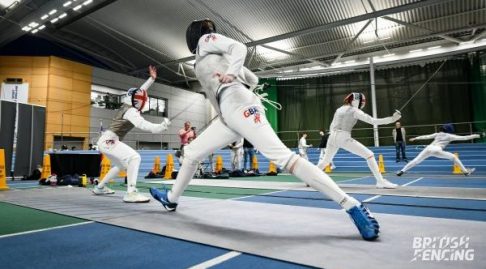
The August GBR Pathway Camp brought together athletes from across the country for two days of intensive training, reflection, and team development. Held at the University of Nottingham’s David Ross Sports Village.
Across all three weapons – foil, sabre, and epee – athletes engaged in scenario-based sparring, collaborative exercises, and open discussions designed to challenge their thinking and elevate their performance under pressure.
Foilists focused on competition preparation, with sessions tailored to help athletes build consistency and tactical clarity in both poule and Direct Elimination (DE) formats. Structured poule simulations encouraged fencers to maintain focus across multiple bouts, manage energy levels, and adapt quickly to different fencing styles. Individual performance analysis played a key role, prompting athletes to reflect on their tactical choices, mental preparation, and bout management strategies.
Pre-competition routines were also a central theme, with athletes exploring warm-up protocols, mental readiness techniques, and strategies for staying composed and confident throughout an event. Group discussions provided a space for foilists to share experiences and explore how to build resilience and tactical awareness under pressure.
The foil sessions were led by coaches Dan Robinson and Marco Zaffino, with mentoring support from Will Lonsdale.
Sabreurs at the camp worked intensively on tactical control and adaptability, with a particular emphasis on asserting dominance in the centre of the piste. Through targeted drills, athletes developed the ability to apply pressure early in the bout and maintain control through active footwork and blade presence.
Adaptability exercises challenged fencers to shift tactics mid-bout in response to opponent behaviour, scoreline, and timing. DE scenario simulations helped athletes manage momentum and make quick decisions under competitive pressure. Group reflections and tactical discussions allowed sabreurs to share insights on bout strategy and mental preparation, reinforcing the importance of composure and resilience in high-stakes situations.
Coaches Fran Whalley, Phil Shepherd-Foster, and Can Aydin guided the sabre sessions with a strong focus on tactical growth and mental discipline.
Epeeists explored the theme Inside the Distance, using progressive sparring formats and scenario-based exercises to refine their decision-making and distance control. The camp provided a valuable opportunity for athletes to develop tactical confidence and composure, particularly in late DE bout simulations where clarity and calm execution were key.
Peer-led reflection was a standout feature of the epee sessions, with athletes analysing their own fencing and offering constructive feedback to teammates. This collaborative approach fostered a strong sense of accountability and mutual support.
On Day 2, the focus shifted to team events, where athletes explored team strategy, communication, and identity – building a shared understanding of what it means to represent GBR. Discussions also touched on the future of epee within the pathway, giving athletes a voice in shaping the direction of their development and the broader programme.
The epee coaching team included Ian Lichfield, Oana Puiu, Tom Bennett, and Lorraine Rose, who brought a wealth of experience and insight to the sessions.
The energy and commitment shown by all athletes and coaches made this camp a meaningful step in the GBR Pathway journey.
Next Camp:
Date: 13th – 14th December 2025.
Locations: Nottingham Jubilee (Epee and and Foil) and Cardiff (Sabre and Para).
Don’t miss the latest news. Subscribe to our weekly summary email, The Fencing Digest, including the previous week’s latest news and announcements. Sign up here.